
CE Marking Explained (2026): Step-by-Step Process for Manufacturers
CE marking explained step by step for manufacturers in 2026. Learn applicable directives, testing, technical file requirements, and how to ensure compliance in Europe.
CE CERTIFICATION
TauroCert
3/30/2026
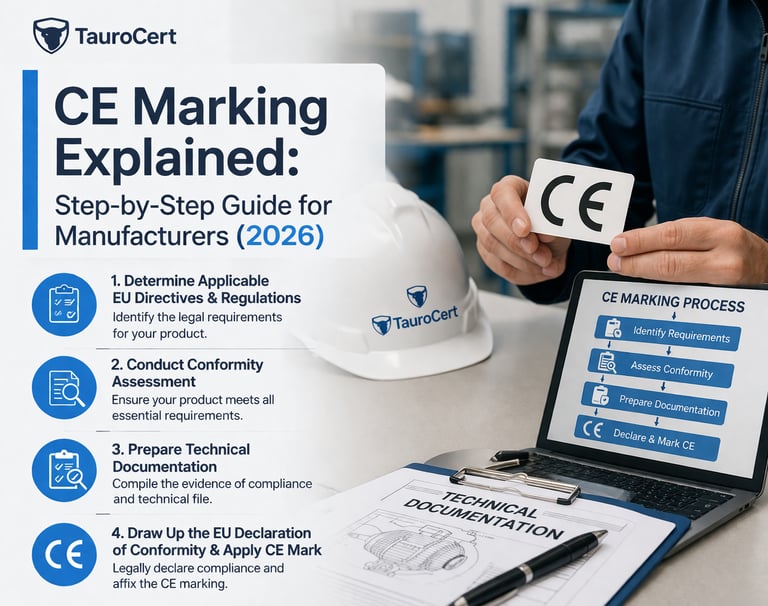
CE Marking Explained: Step-by-Step Guide for Manufacturers (2026)
Introduction
If you want to sell products in the European Economic Area (EEA), CE marking is not optional, it’s mandatory.
Yet for many manufacturers and product teams, CE marking can feel complex, confusing, and risky.
Which directives apply? What tests are required? Do you need a notified body?
This guide breaks it all down into a clear, practical step-by-step process, so you can understand exactly what is required and how to achieve compliance efficiently.
What Is CE Marking?
CE marking is a declaration by the manufacturer that a product complies with all applicable European Union legislation.
It shows that your product meets essential requirements related to:
Safety
Health
Electromagnetic compatibility
Environmental protection
Radio and cybersecurity (for connected products)
Once CE marked, your product can be freely sold across the EU and EEA.
Step 1: Identify Applicable Directives and Regulations
The first and most critical step is determining which EU legislation applies to your product.
Common examples include:
Low Voltage Directive (LVD)
Electromagnetic Compatibility (EMC) Directive
Radio Equipment Directive (RED)
Machinery Directive / Regulation
RoHS & REACH
Ecodesign & Energy Labelling
👉 Many products fall under multiple directives at the same time.
Mistake to avoid:
Missing a directive can invalidate your CE marking entirely.
Step 2: Determine Applicable Standards
Once directives are identified, the next step is selecting the relevant harmonized standards.
Standards define how to demonstrate compliance in practice, for example:
Electrical safety (e.g. EN 60335, EN 62368)
EMC emissions and immunity (EN 55014, EN 61000 series)
RF performance (ETSI standards)
Using harmonized standards gives you presumption of conformity, a key advantage.
Step 3: Perform Risk Assessment
A formal risk assessment is required to identify potential hazards and ensure your product is safe.
This includes:
Electrical hazards
Mechanical risks
Thermal risks
Cybersecurity risks (for connected devices)
Misuse scenarios
The outcome must be documented and reflected in your design and documentation.
Step 4: Testing and Compliance Verification
Your product must be tested to verify compliance with applicable standards.
This may include:
Safety testing
EMC testing
RF testing
Environmental or performance testing
Testing can be done:
Internally (if you have capability)
Or through accredited laboratories
Step 5: Notified Body (If Required)
Some products require involvement of a Notified Body (third-party certification).
Examples:
Certain radio equipment (RED)
Medical devices
Complex machinery
However, many products can be self-certified by the manufacturer.
Step 6: Prepare the Technical Documentation (Technical File)
The Technical File is one of the most important elements of CE compliance.
It must include:
Product description
Applicable directives and standards
Risk assessment
Test reports
Design drawings and schematics
User manuals and labeling
Declaration of Conformity
⚠️ This documentation must be available for authorities for at least 10 years.
Step 7: Draft and Sign the EU Declaration of Conformity (DoC)
The Declaration of Conformity is a legal document stating that your product complies with all applicable EU requirements.
It must include:
Manufacturer details
Product identification
Applicable directives and standards
Signature of responsible person
Step 8: Affix the CE Marking
Once all steps are completed, the CE marking can be affixed to the product.
Requirements:
Visible, legible, and permanent
Correct proportions
Placed on the product (or packaging if necessary)
How Long Does CE Certification Take?
Typical timelines vary depending on complexity:
Simple products: 4–6 weeks
Medium complexity: 2–4 months
Complex / RF / multiple markets: 5–7+ months
Planning early can significantly reduce delays.
Common Mistakes to Avoid
Not identifying all applicable directives
Using incorrect or outdated standards
Incomplete technical documentation
Ignoring cybersecurity requirements (increasingly critical)
Starting certification too late in product development
Final Thoughts
CE marking is not just a regulatory obligation, it is a strategic step in bringing your product to market.
When done correctly, it ensures:
Faster market access
Reduced risks
Higher product credibility
When done incorrectly, it can lead to delays, recalls, or legal issues.
Need Help with CE Marking?
Navigating CE requirements can be complex, especially when dealing with multiple directives, testing requirements, and documentation.
👉 TauroCert supports manufacturers at every stage of the compliance process, from identifying requirements to certification strategy, testing support, and technical documentation.
Book a free consultation to discuss your product and get a clear path to compliance.